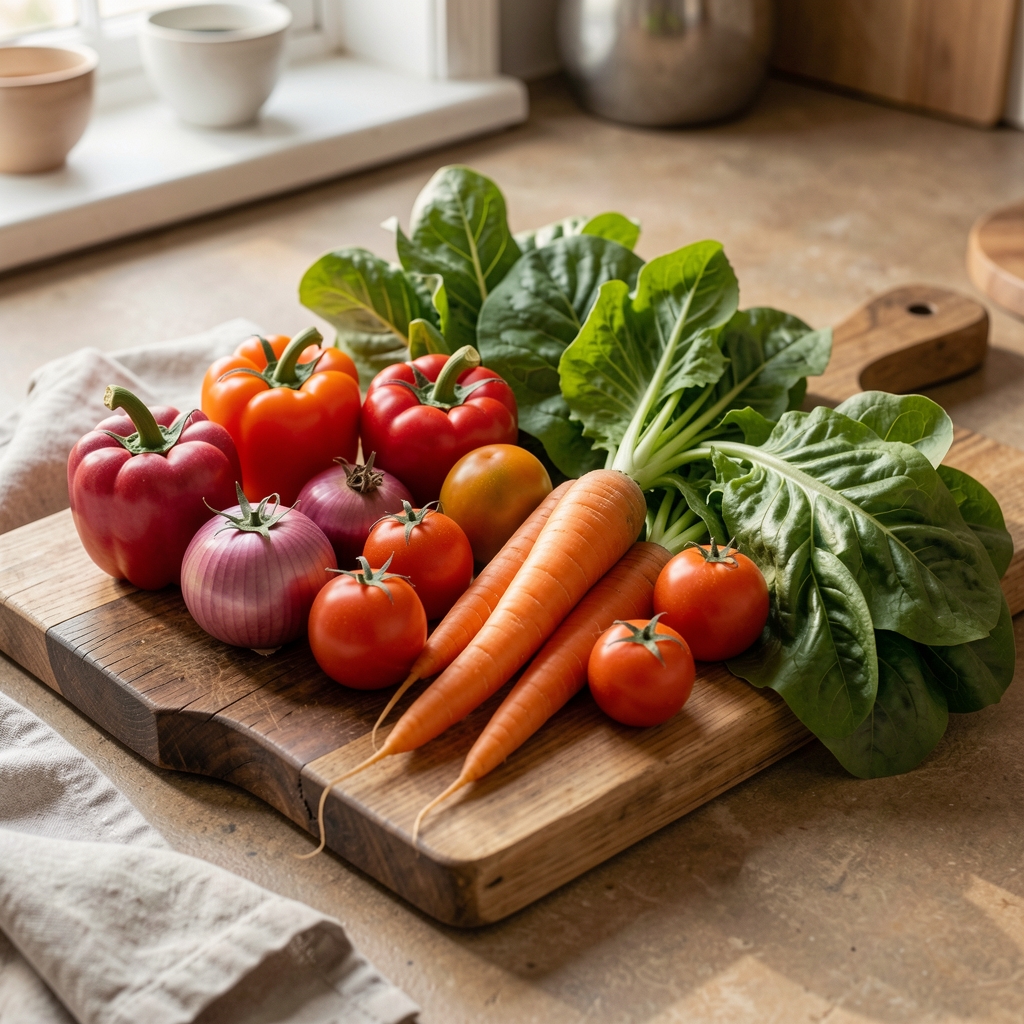
There is a particular quality to the weight of a winter plate — heavier, slower to empty, resistant to the idea of reduction. Over the past four years of keeping a food record, the same pattern has emerged each October: the stalls at the market shift from tomatoes and courgettes to parsnips and cavolo nero, and something in the proportioning of a meal quietly changes in response.
What the Market Stall Tells You
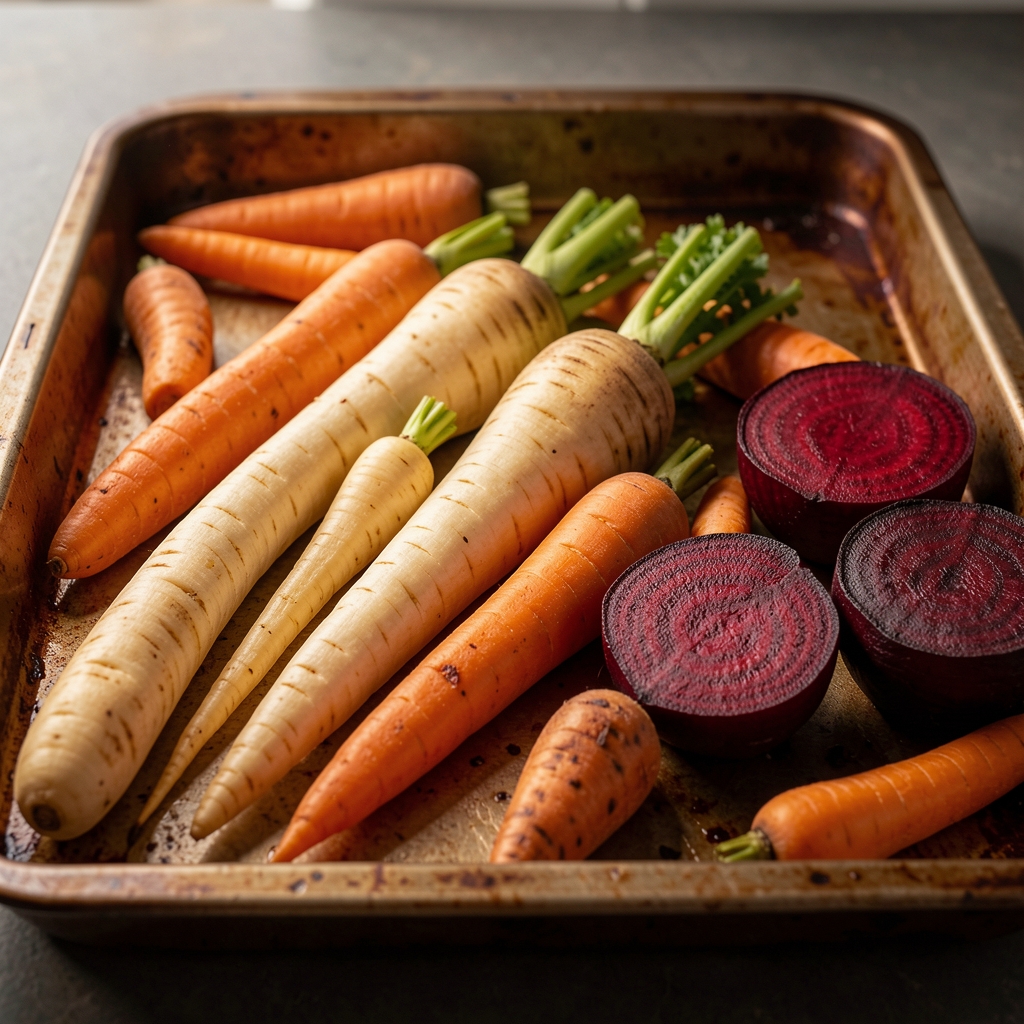
The argument for seasonal eating is often made in terms of sustainability or flavour. It is rarely made in terms of weight awareness — yet a nutritionist spending time at a London market in late autumn will notice something that deserves attention. The produce that arrives in October is, almost without exception, denser in energy than what it replaces. Root vegetables, brassicas, squashes: these are foods that carry more per gram and tend to be cooked with additional fats — roasted, braised, enriched by the oven. The summer salad that required no more than oil and a torn herb has been replaced by a tray of root vegetables that asks for much more.
This is not, in itself, a problem. The nutritional variety offered by autumn and winter produce is considerable — cavolo nero in particular offers exceptional fibre and micronutrient density relative to its caloric load. But the shift in preparation method matters. Boiling and steaming, which dominate summer cooking, are replaced by roasting and slow-cooking, which typically involve more added fat. The plate changes not just in its contents but in how those contents are handled before they arrive at the table.
Over four consecutive autumns of detailed food journalling, I have observed a consistent pattern: the weeks immediately following the seasonal shift in market produce are weeks in which reported satiety decreases despite higher caloric content. This is not a paradox; it reflects the well-documented relationship between food texture and fullness — rough, fibrous summer salads tend to produce satiety signals faster than smooth, dense winter stews. The portion that felt complete in August does not feel complete in November, and the response, typically, is to eat more.
The Role of Cooking Method in Portion Awareness
Portion awareness — the capacity to assess how much one is eating without necessarily measuring — is significantly influenced by the visual presentation of food. A large bowl of dressed leaves reads, visually, as substantial. A small ramekin of roasted vegetable mash may contain more energy but reads as modest. This visual shorthand is not a failure of intelligence; it is a natural consequence of how the human perceptual system evolved. Volume signals were more reliable historically than caloric density signals, because caloric density was relatively stable within food categories. It is only in the context of heavily processed foods — and, more subtly, in the context of seasonal cooking — that the relationship between visual volume and actual energy content becomes meaningfully distorted.
The practical consequence for anyone maintaining a food journal through the seasonal transition is that the reference points built up during summer need to be recalibrated in autumn. A portion of roasted butternut squash that appears similar in volume to a summer bowl of cucumber and tomato may contain two to three times the energy. This is not a reason to avoid butternut squash — it is an excellent whole food and supports sustained energy through the day. But it is a reason to remain attentive to the change in portion logic that autumn cooking demands.
In my own records, I have found that the most effective adjustment during seasonal transitions is not to measure but to slow down. The relationship between eating pace and satiety signalling is well documented in nutritional research: eating more slowly allows time for fullness cues to register before the portion is complete. In summer, when lighter foods require more chewing, this tends to happen naturally. In winter, smooth soups and braised dishes require very little mechanical processing, and the pace of eating tends to accelerate. The simple act of setting a spoon down between mouthfuls, which reads as a minor instruction, has a measurable effect across several weeks of practice.
"The seasonal shift in produce does not announce itself dramatically. It arrives quietly, at the market stall, and is absorbed without notice into the rhythm of a weekly shop — until the record shows something that the memory does not."
Vegetables, Fruit, and the Winter Balance
One of the consistent findings from four years of seasonal food journalling is the degree to which fruit intake declines during winter months in ways that are not fully compensated for by increased vegetable consumption. In summer, fruit appears casually — on a desk, in a bag, eaten without deliberate thought. In winter, fruit becomes a considered purchase: the nectarines and plums are gone; what remains is apples and pears, which are excellent, but which require a different kind of attention to include regularly.
The consequence, in terms of dietary fibre and micronutrient variety, is meaningful. Fibre supports a sense of fullness between meals — this is one of its most practically relevant functions for anyone paying attention to weight over time. A winter diet that is rich in roasted root vegetables but low in raw fruit and fresh salads tends to be denser in energy and lower in fibre than its summer equivalent. The gap is rarely dramatic in any single week, but across an entire winter it accumulates.
The adjustment I have found most reliable is structural rather than effortful: building fruit back into the architecture of the day in winter requires placing it where it will be encountered without deliberation. A bowl on the counter, rather than a bag in the fridge. An apple beside the kettle rather than a biscuit. These are not dramatic interventions — they are responses to the observation that winter reduces fruit intake through proximity, not through preference.
- 01 Seasonal transitions change cooking method as much as ingredients — roasting replaces steaming, and preparation method significantly affects caloric density per visible portion.
- 02 Winter produce tends to be energy-denser per volume than summer produce, which disrupts established portion reference points built up over the preceding months.
- 03 Fruit intake reliably declines during winter months without conscious decision — structural placement (bowl on counter vs. bag in fridge) produces consistent improvement in daily intake.
- 04 Eating pace tends to accelerate with winter foods — smooth soups and stews require less chewing, reducing the time available for satiety cues to register.
The Value of Keeping the Record Through Winter
Food journalling is often recommended as a weight-management practice, and the recommendation is sometimes met with resistance on the grounds that it creates an unhealthy relationship with eating. This objection deserves a considered response. A food journal, kept with curiosity rather than judgment, does something rather specific: it creates a record from which patterns can be observed at a distance that ordinary experience does not provide. The seasonal shift described in this article is genuinely difficult to notice in real time. It is legible only in retrospect, when weeks of records reveal what daily experience obscures.
The purpose of noting what one eats is not to restrict — it is to see. Restriction is a response to seeing, and one that is entirely optional; many food journallers find that observation alone, without any accompanying change in habit, produces gradual and durable shifts over time. The act of attending to what is eaten changes the experience of eating in ways that do not require an act of will. It is, in this sense, a practice rather than a discipline — closer to note-taking than to rationing.
The winter record is worth keeping not because winter is a period of dietary failure — it is not — but because it is a period during which the variables change quietly and without announcement. The record is how the change becomes visible.